Download our methodology brief to learn more about making credible claims in complexity with the Impact Garden.
Note: The brief is specifically for multilateral institutions and international aid organisations. Another brief for foundations and investors is coming soon. While the methodology in each brief is identical, the framing and applications are slightly different.
Watch the recording or access the slides and worksheet from our free workshop where we presented this methodology.
Whether you are a program officer at a UN agency, a trust-based philanthropist, or a network weaver, you likely face the same fundamental tension. You are working to solve complex, non-linear problems. Yet, the tools available to measure that work - logframes, linear theories of change, and standard KPIs - are often rigid and extractive.
We try to fit living ecosystems into boxes. We struggle to capture the "invisible" value of trust, connection, and agency, risking the oversight of structural inequities. The result is a measurement gap that shows up differently for everyone:
In all cases, we know our work is creating value, but we struggle to make a credible claim about that impact in a way that satisfies a board, a donor, or a public auditor.
At Unity Effect, we have spent the last few years wrestling with this challenge alongside partners like the ILO, Social Entrepreneurship Network Germany (SEND e.V.) or FLOCERT.
The result is an integrated approach designed to bridge the gap between the rigor required for reporting and the reality of working in complexity towards systemic and equitable change. It brings together four distinct innovative elements:

These four components weave together into our analytical methodology for making credible claims, weaving data into systemic narratives.
Here is a closer look at these ingredients and how they come together in the analytical methodology.
First, we must shift how we approach inquiry. Regenerative Evaluation is evaluation in service of life. It moves us beyond the dynamic of extraction—mining data from "subjects"—toward a practice that enhances the vitality of the systems we engage with .
Regenerative Evaluation weaves together three essential strands of evaluation into a coherent practice for the polycrisis :
In this paradigm, we do not measure to control the system; we measure to nourish it. We acknowledge that the act of asking questions leaves marks, and we design our inquiry to build capacity and strengthen relationships in the process.
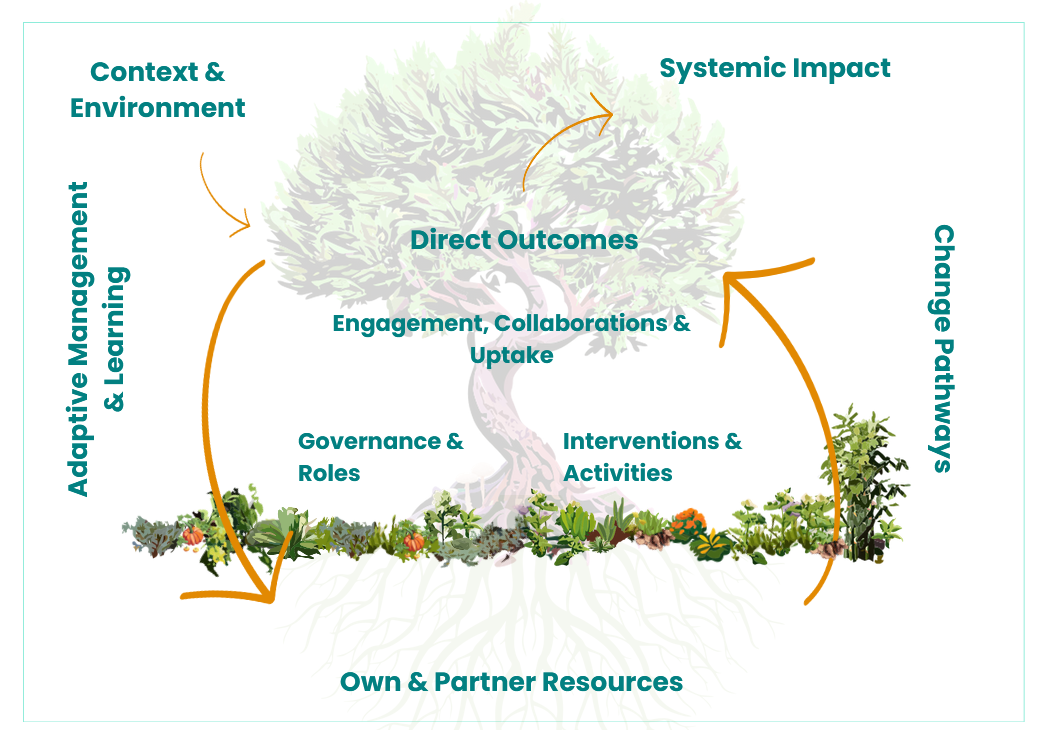
To navigate complexity, we need a map that reflects reality. The Impact Garden is a Visual Theory of Change framework. Unlike linear logic models that imply a straight line from Input → Output, the Impact Garden maps the ecosystem of change.
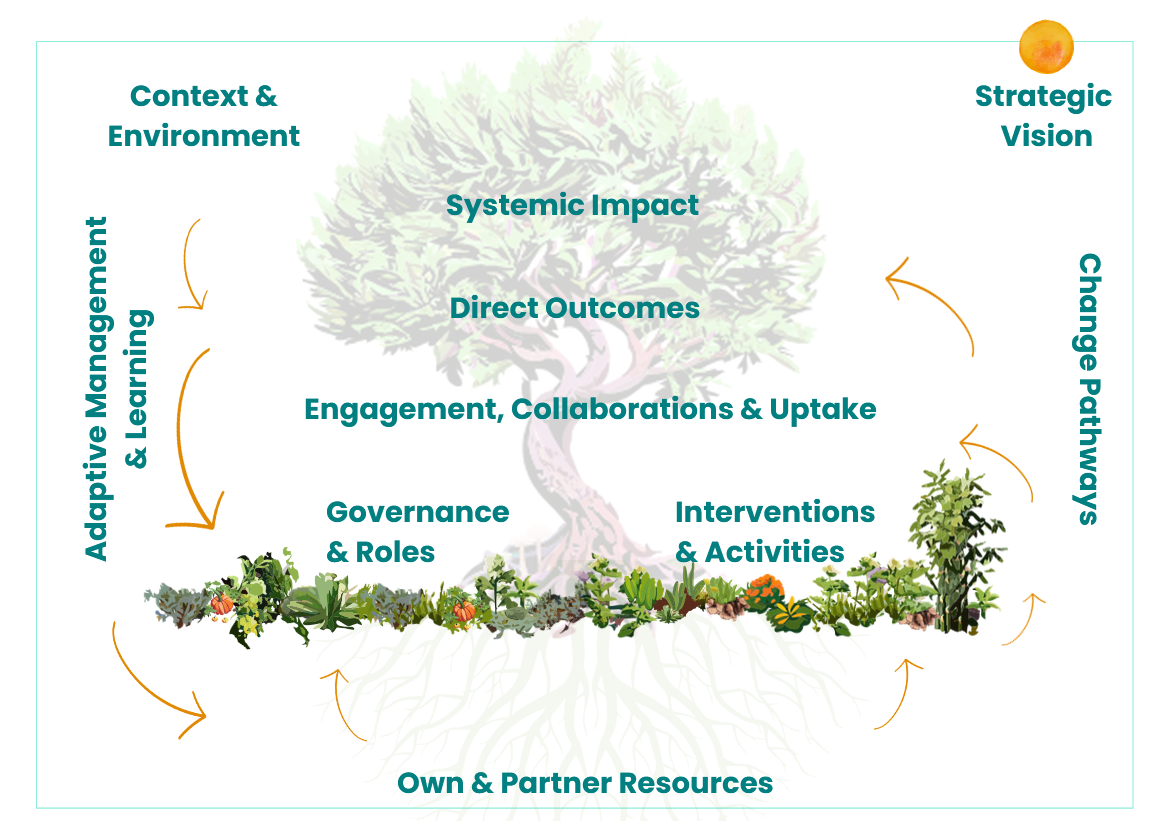
It visualizes the "invisible" conditions of success—the Soil (Own & Partner Resources, including Indigenous rights recognition and community social capital) and the Garden Bed (Interventions & Activities)—alongside the visible Fruit (Direct Outcomes) and Seeds & Spores (Systemic Impact). It formally integrates External Conditions (Weather) to map external forces, especially potential justice-related risks like discrimination or land tenure conflicts. This allows diverse stakeholders—from local communities to global funders—to see their contribution on a single, intuitive map, creating strategic alignment without oversimplification .
In complex systems, significant outcomes often emerge long after an intervention, creating a "measurement gap." If we only look for results, we miss the early signs of progress and potential power imbalances.
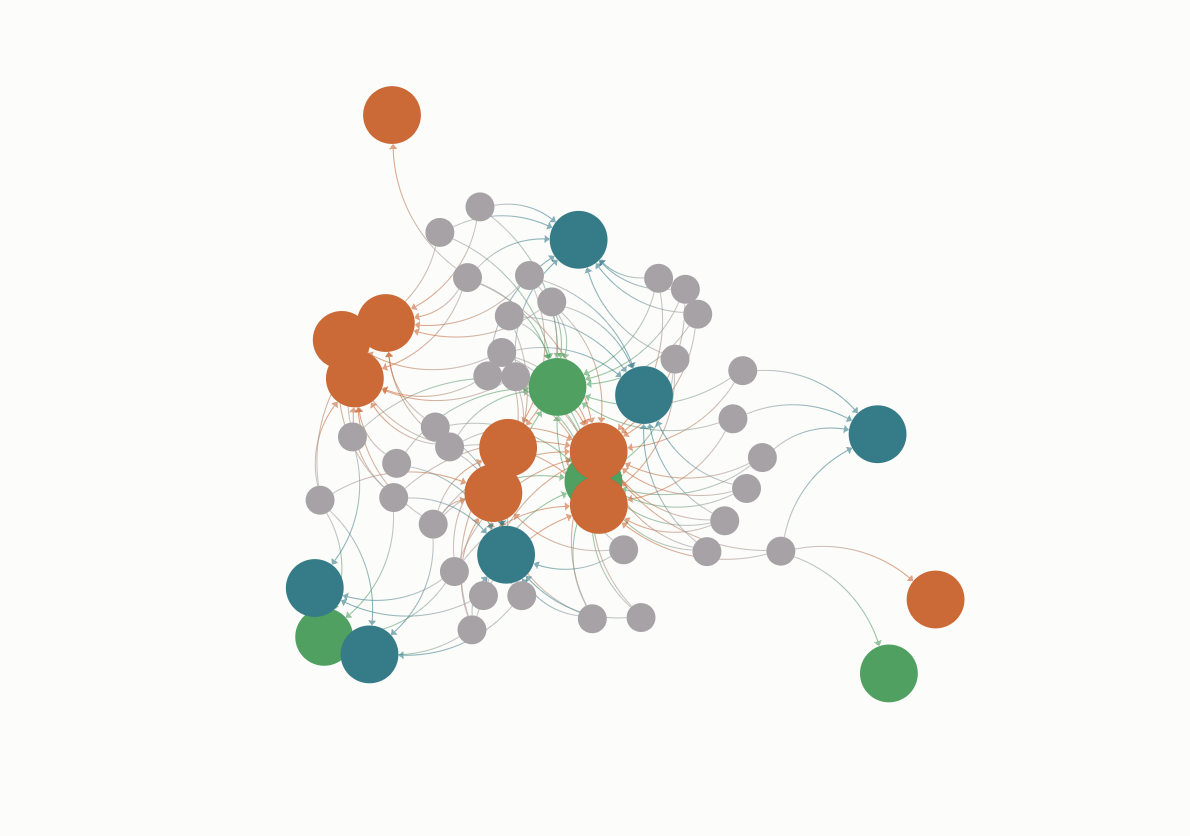
Our methodology moves beyond static indicators to measure feedback loops - the dynamic relationships between data points (e.g., how a successful training program builds capacities, which then become part of the system’s resources in the form of peer-coaches).
By tracking these connections, we identify the systemic health and capacity for self-determination of the project. These loops serve as indicators for Systemic Vitality, allowing us to report on the resilience, equity and potential of a system, therefore explaining why and how change unfolds. For example, a trust loop is essential for building the psychological safety required for marginalized and underrepresented voices to contribute freely, which in turn brings about new possibilities for a project or change initiative.
Finally, how do we turn these insights into evidence? One core challenge in complexity is synthesizing data without losing nuance. We achieve this through a rigorous analytical methodology. Regenerative Evaluation serves as the lens and the Impact Garden as the visual evaluation framework.
We then bring together four steps leading up to credible claims:
Following these steps enables one to clearly understand one's own contribution to sustained change and impact.
While this methodology is universal, the value it unlocks is specific to your role. In our upcoming Methodology Briefs, we tailor this approach to three distinct contexts:
The Impact Garden methodology equips organizations to move beyond box-ticking and rigorously demonstrate alignment with global mandates, including the SDGs, Kunming-Montreal Global Biodiversity Framework, and international Human Rights treaties. By operationalizing concepts like Recognition, Procedural, and Distributive Justice into measurable indicators, it transforms abstract commitments on gender equality and indigenous rights into verifiable evidence of systemic change.
Download our methodology brief to learn more about making credible claims in complexity with the Impact Garden.
Note: The brief is specifically for multilateral institutions and international aid organisations. Another brief for foundations and investors is coming soon. While the methodology in each brief is identical, the framing and applications are slightly different.
Watch the recording or access the slides and worksheet from our free workshop where we presented this methodology.
Curious about how this methodology could support your work? Book a conversation with our team or send us a message.