Health and vitality in teams, organisations and networks is often felt intuitively, but rarely measured with rigour. We know when a team is "alive" and when it is stagnant. We know when a network is "generative" and when it is draining. But in the landscape of organisational development and systems change, we often lack the empirical data to explain why.
We are inviting academic partners to join us in a shared inquiry into the real-world conditions that enable systems change. By combining our anonymised data from the field with your research expertise, we aim to bridge the gap between theory and practice, deepening our collective understanding of how regenerative practice actually functions in teams, organisations and networks that aspire to create systemic change.
The fields of systems change and regeneration are rich in theory. Concepts from complexity science, salutogenesis, and developmental psychology offer profound maps for how healthy systems should function. However, there is often a disconnect between these theories and the messy, dynamic reality of daily organisational life.
Practitioners often face a choice between tools that are rigorously scientific but inaccessible (expensive, rigid, or disconnected from practice), or tools that are practical but lack scientific validity.
We believe the field needs Practice-Based Evidence. We need to learn from the living systems we are supporting - gathering in the real-time dynamics of teams, organisations, and networks.
We are not starting from zero. Over the years, Unity Effect has developed substantial, tested frameworks that are currently supporting hundreds of individuals and teams. These tools generate a rich stream of data regarding the "invisible" drivers of success.
Our framework for activating human potential, the Capacity Compass, was built on a comprehensive consolidation of experiential knowledge and academic insights. To create it, we dove into academic articles, talked to experts and set up two major databases containing over 75 validated psychological and organisational assessments and 2,000+ individual items.
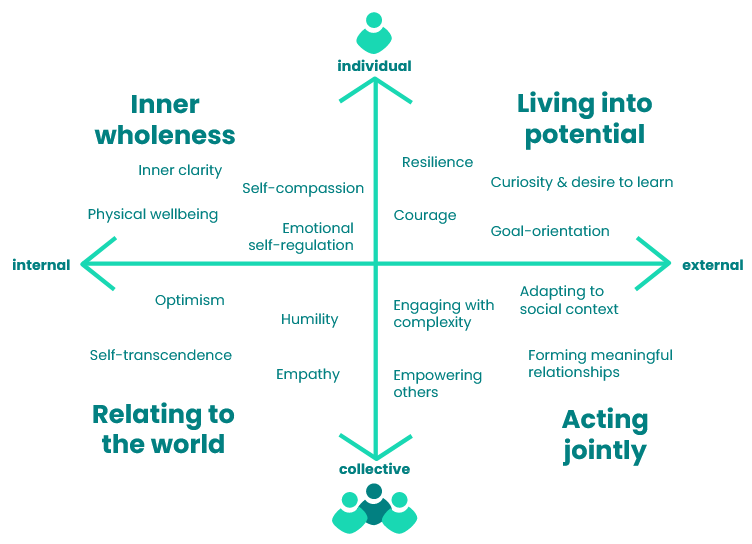
This tool allows us to gather granular insights on "hard-to-measure" capacities like Inner Clarity, Psychological Safety, and Resilience. For researchers, this offers a unique opportunity to correlate inner capacity development with external impact and team performance.
To read more, have a look at our case study on evaluating our Purpose Journey and our blog article on the Capacity Compass. Or take our Personal Agency Scorecard to experience the Compass in application.
While the Compass looks inward, the Impact Garden looks outward at the ecosystem. We use this framework as a Theory of Change in Monitoring & Evaluation, and have developed a methodology to make Credible Claims in Complexity. Rather than relying on linear attribution (which often fails in complex systems), the Impact Garden maps the role of specific conditions - e.g. the "Soil" (Resources) and "Water" (Adaptive Management & Learning) - to understand one's contribution to the "Fruits" (Outcomes) and systemic changes.
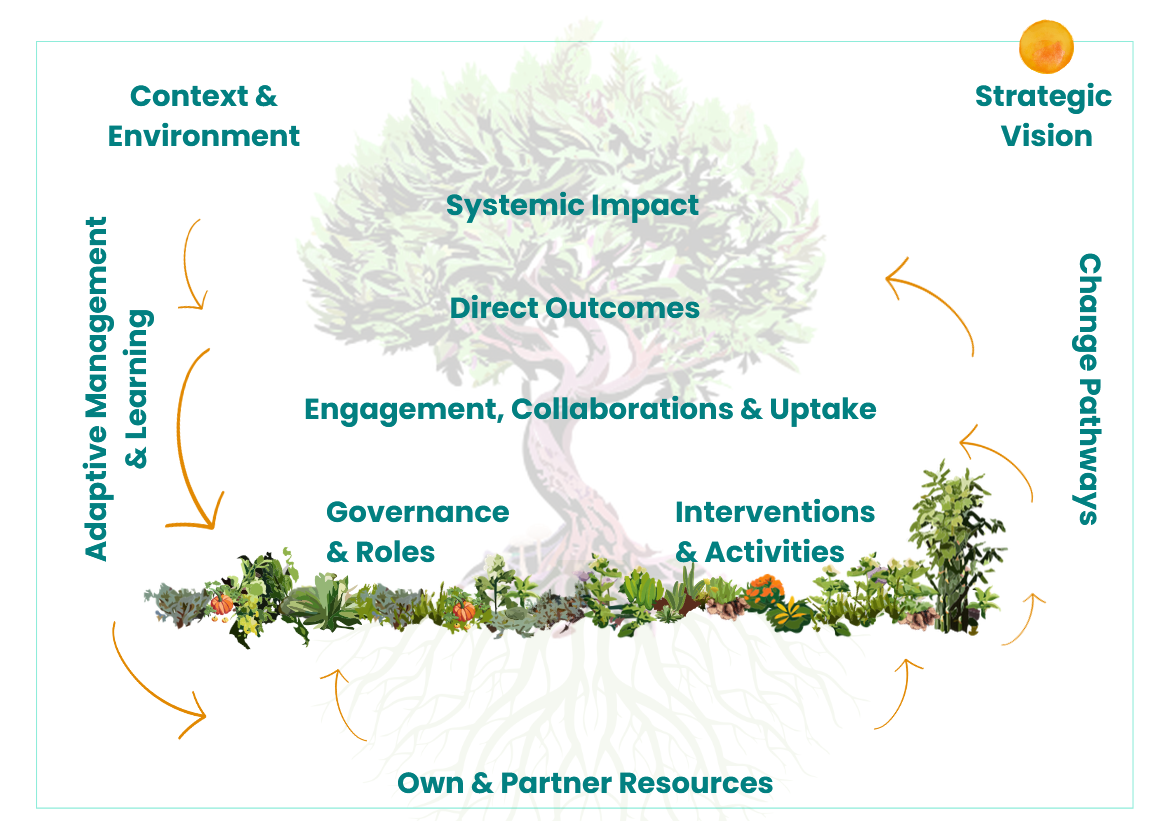
The Impact Garden has been applied to evaluate over €1.5 million in investments and has been used by more than 500 practitioners.
A second application of the model is to understand and measure Systemic Health and Vitality in teams, organisations, and networks. Through our assessments, we are generating unique data on the "Health Clusters" of organisations. This allows us to move beyond performance metrics to analyse the structural and relational root causes of vitality and sustained impact.
We are no strangers to the rigors of academic inquiry. Bridging the practitioner-academic divide is part of who we are, and we've had the chance to work with different academic partners such as:
We speak the languages of both worlds, and we understand the importance of methodological integrity.
We are seeking partnerships with PhD candidates, researchers, and departments to explore questions such as:
Trust is our foundation. We are committed to the highest ethical standards in handling the data entrusted to us.
We believe that knowledge grows when it is shared. We are not looking for proprietary insights to keep behind closed doors and stand for:
Are you a researcher or institution looking for a "field site" to test theories of regenerative organisation? Do you want access to real-world data that bridges the gap between complexity theory and practice?
Let’s talk. We are ready to open our books and explore what we can discover together. Book a conversation or send us a message.